
Searching Jackson County Civil Dockets
All public civil case searching for Jackson County runs through the statewide North Carolina eCourts Portal. Start in Smart Search. Use an exact record number or a party name. From there, use Advanced Filtering to lock the location to Jackson County. Documented filters include case type, status, and filing-date range. The Portal's public categories cover Civil Actions, nonconfidential Special Proceedings, and Estates. Anonymous users can view the public information. Registering an account saves cases; it does not unlock nonpublic records.
Once a likely case turns up, open its Case Summary or Register of Actions. Work through the assignment and parties. Add Causes of Action when present, Case Events, Hearings, Dispositions, and Financial Information if applicable. For a current setting, check Jackson's civil calendar. Portal Search Hearings helps too. Need a paper file? What about a public image that is not online, an official document, or a verified result? Contact the Jackson County Clerk of Superior Court. You can also use the public self-service terminals at the courthouse.
- Search Smart Search with the precise record number or party name available.
- Narrow the location to Jackson County and add case-type, status, or filing-date filters only when needed.
- Open the Case Summary and compare the parties, assignment, case events, and hearing information.
- Check Search Hearings and the Jackson civil calendar before relying on a listed date.
- Ask the clerk for access to a public case file, a copy, or a certificate under seal when the online record is not enough.
Jackson County Civil Portal Filters
Smart Search splits a broad first pass from the refinement stage. Portal guidance documents search fields. A party name, case or file number, attorney details, business name, cross-reference number, and more all work. A record number has several parts. It combines a year, case-type letters, a six-digit sequence, and a three-digit county identifier. A wide name search can then be narrowed. Refine by location, case type, case status, date of birth where applicable, and filing-date range. One caution: a result list is not the civil docket itself. Open the Portal's full Case Summary before drawing conclusions.
Don't confuse the Remote Public Access Program with a tool for one Jackson civil case lookup. That program covers official data-extract and licensing information for bulk users. A person hunting a single public civil record has simpler routes. Stick with Smart Search, Search Hearings, the county calendar, and the clerk's file channels. Knowing the difference keeps a simple record request from landing at a statewide program built for another purpose.
The Judicial Branch Remote Public Access Program page is the official source. It backs this Jackson County civil docket information.
Statewide data services and a public search for one particular Jackson civil case are two different things, and the source draws that line clearly.
Note: Live Portal controls can change, so recheck the available labels before relying on a specific dropdown or filter.
Inside a Jackson County Civil Docket
The civil Case Summary follows a documented field structure, which beats guessing at local codes. Case Information and Assignment Information set the case context. Party Information lists the public participants. Causes of Action can appear in civil, family, probate, and mental-health matters alike. Case Events form the chronological register. Hearings, Dispositions, and Financial Information each answer a different question about the case. Public documents may be viewable one at a time. But the Portal itself never becomes the official record.
| Case header | Case Information and Assignment Information provide the available number, court, and case-type context. |
|---|---|
| Parties and attorneys | Party Information may appear; attorney name and bar number are documented search criteria when recorded. |
| Causes of Action | A civil, family, probate, or mental-health classification or claim detail when the Portal has it. |
| Case Events | The chronological register of filings and court actions. Jackson research did not locate a local event-code chart. |
| Hearings and outcome | Hearings show scheduled activity; Dispositions and Financial Information appear when applicable and may be absent. |
Keep one distinction in mind. A filed complaint, answer, motion, order, or judgment is a document; an event label on the docket merely refers to it. When a public underlying document is not available online, the clerk is the right Jackson case-file channel for getting it.
Jackson County Civil Court Levels
Court level is the sharpest first cut in any Jackson civil docket search. Superior Court takes major civil money-damages cases over $25,000. District Court handles money-damages cases through $25,000 plus family matters. Small claims go to magistrates within District Court, capped at $10,000 under statewide guidance. Specified personal-property and lien matters go there too. Estates and nonconfidential special proceedings belong to the clerk. They carry their own Portal filters. Across that whole map, one Jackson Clerk of Superior Court holds the files.
| Jackson civil matter | Court path | Primary public channel |
|---|---|---|
| Money damages over $25,000 | Superior Court | Portal Smart Search, civil calendar, and clerk file |
| Money damages through $25,000 or family matter | District Court | Portal, Search Hearings, civil calendar, and clerk file |
| Small claim through $10,000 | Magistrate within District Court | Portal and clerk or magistrate channels |
The official Superior Court source supplies this Jackson County civil docket jurisdiction image.
That structure explains why a court assignment, not a loose label like civil, should steer the first search and calendar check.
Civil Case Types on the Docket
Statewide court structure sets the map. The Portal's filters define the case categories on a Jackson County civil docket. Civil Actions cover money-damages disputes at the matching court level. District Court also hears family matters. Magistrate small claims form a separate limited-amount route inside the District Court division. Estates and nonconfidential special proceedings stay with the clerk. The Portal's civil field inventory names Causes of Action for civil, family, probate, and mental-health cases whenever that information is available.
- Superior Court civil actions for money damages over $25,000.
- District Court civil actions through $25,000.
- District Court family matters.
- Magistrate small claims through the statewide $10,000 guidepost.
- Nonconfidential estates and special proceedings handled through the clerk system.
A small-claims appeal gets tried anew in District Court. Its later record can therefore show up under a different court level or case sequence than the original magistrate matter.
Jackson County Civil Case Events
Civil cases tend to move in a familiar order. The state's own guidance lays it out without promising any timetable. A complaint gets filed and served first. The defendant then has 30 days to answer. From there a Jackson County civil docket may show discovery, motions, hearings, an order or judgment, and appeal activity. Skip the answer and default judgment becomes possible. Every case runs on its own facts, so treat this sequence as a reading aid rather than a fixed local schedule.
The official lawsuits reference shows these civil docket stages for Jackson County cases.
Those statewide stages map onto a public Jackson County record. Case Events and hearing details carry them there.
One stage deserves its own note. A District or Superior Court decision is sometimes appealed. The case usually heads then to the North Carolina Court of Appeals. That appeal creates a separate appellate case record, even though the Jackson civil file already shows a notice of appeal. The docket you are reading is no longer the whole story at that point.
Civil Docket Settings and Hearings
Four tools get confused for each other, so keep them straight. A Jackson civil calendar, a seasonal District Court schedule, Portal Search Hearings, and a Case Summary each do different work. The county's Local Administrative Schedules page links the spring and fall District Court schedule materials plus direct civil-calendar access. A schedule tells you how a session is structured. A calendar lists which cases landed in it. Need the current setting on one case? Search Hearings and the Case Summary are the live route. When a civil date matters, compare them.
A continuance pushes a setting back. It does not end the case. Once a continuance request is decided, check the Case Summary and Search Hearings again. A trial week is not the same as an individual trial day. A stale calendar proves nothing about whether a case moved. Records conflict or look outdated? The Jackson clerk is the place to confirm the real court date.
For a focused date path, see the county's Court Dates page.
Jackson County Civil Docket Documents
Three record layers exist, and mixing them causes trouble. The Portal Case Summary is the public docket register. A filed document is the pleading, order, or judgment itself, sitting in the case file. A certified copy or a certificate under seal from the clerk is the official record when authenticity matters. Portal can show public document images one at a time, but a web image is never the same as a clerk certification.
Need the actual document? Ask the Clerk of Superior Court in those cases. That applies when the item is paper-only, absent from Portal, older, or required in official form. Give the clerk the case number, party names or caption, the court, and the document name or date. Say whether you want a plain copy or a sealed certificate. Jackson County posts no civil copy-request form, guaranteed turnaround, or local ID rule. Confirm current process with the clerk.
The official small-claims guidance lays out the court path for these Jackson County civil docket cases.
One caution before you search. A small-claims docket and its later District Court appeal may sit under different record numbers and court levels, so check both before assuming a case lookup came up empty.
Civil Docket Access Rules
G.S. 7A-109 gives the clerk a job. The clerk must keep files, dockets, and indexes, and open them to public inspection unless some law says otherwise. For a public Jackson civil case, that means three doors: the Portal online, the courthouse public terminal, and the clerk who holds the local file. A public-record request to NCAOC covers only administrative records that NCAOC itself holds. It cannot fetch an individual Jackson case document from the clerk.
Access still has limits. Portal excludes confidential, sealed, expunged, or otherwise restricted records. Registering an account adds nothing to protected material, and Portal can mask date-of-birth details in public results. Reading a register, following a hearing, or finding a document route is fair use. A restriction deserves respect, not a workaround.
Access point: G.S. 7A-109 establishes the clerk's docket-and-index duties and the public-inspection baseline. G.S. 132-6.2 addresses public-record inspection and copy or special-service fees.
Jackson County Civil Docket Limits
A missing Portal item can mean several things. The document may be restricted or sealed. It may be held back from public images, still processing, or filed in another county entirely. A blank financial panel does not prove no balance or judgment ever existed, and a calendar date can be overtaken by a later case event. The public record can fall short. Then go to the clerk, the public terminal, or the current court date channel. Skip third-party record services.
The Judicial Branch Expunctions topic explains the access limits around expunged records. The statute source covers one specified first-offender category. It sets no Jackson civil filing rule. It sets no universal expunction fee either. It appears here for one reason: a restricted result is not automatically an access error.
The official expunction-access source details these Jackson County civil docket limitations.
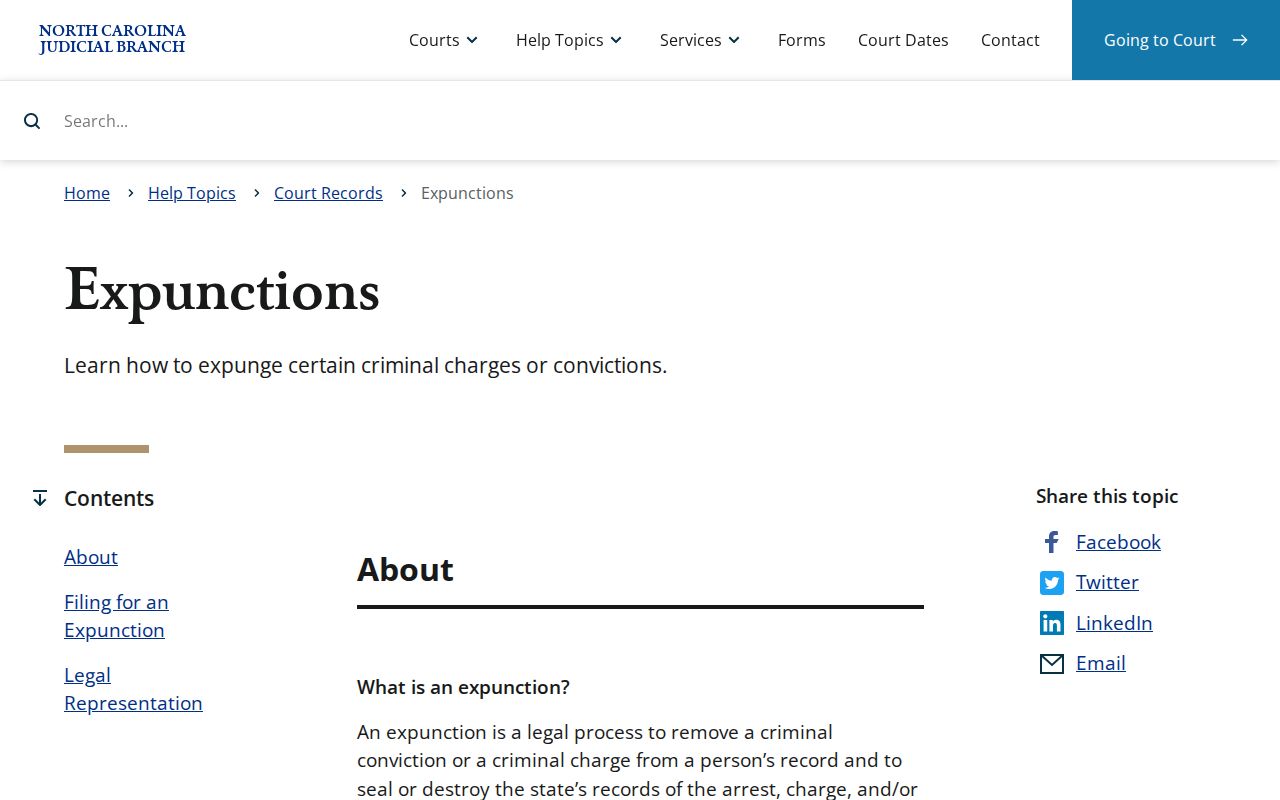
Portal visibility and the clerk's lawful access to a file both turn on the actual record and the governing rule, not on assumption.
The official G.S. 15A-145.7 source gives a second reference on Jackson County civil docket restrictions.
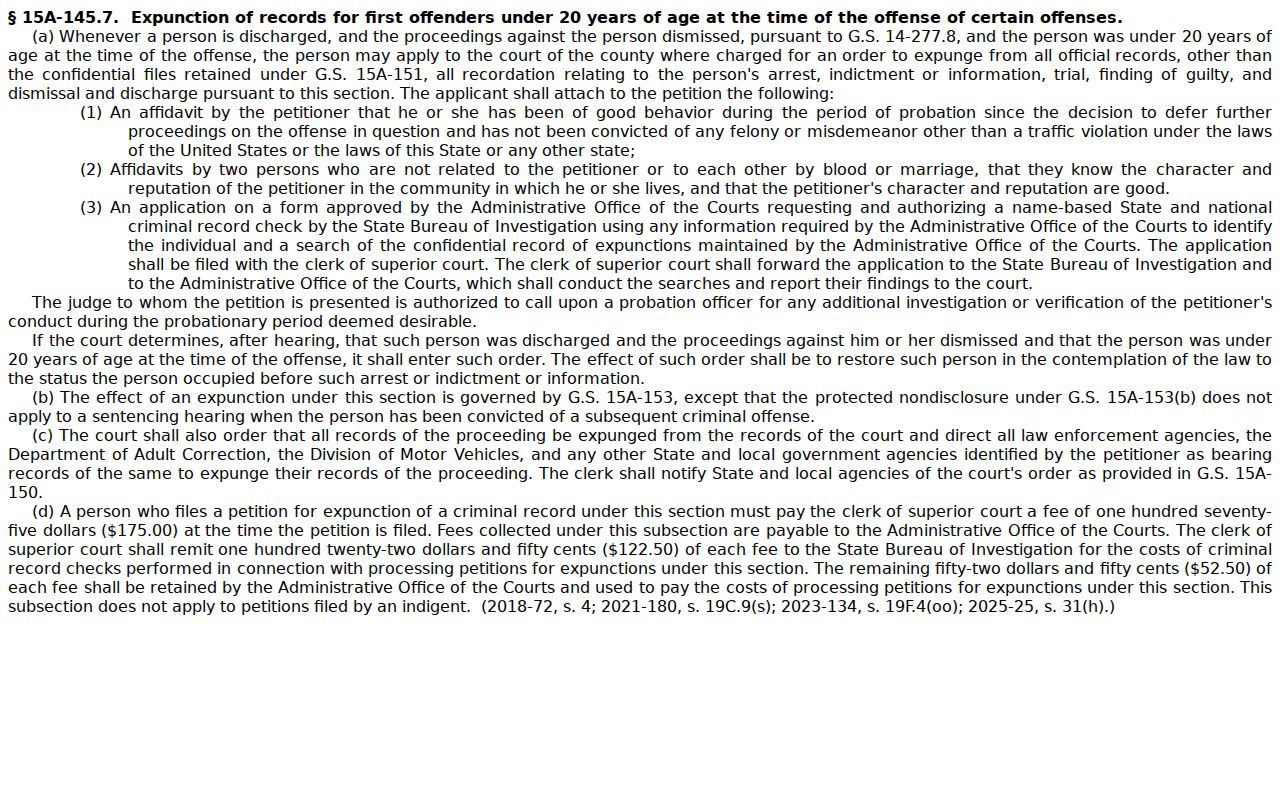
Its expunction rule is narrow. Do not stretch it to a civil file without checking the governing record and statute first.