
Searching Jackson County Criminal Dockets
Jackson County criminal cases live on the statewide North Carolina eCourts Portal. They are not in a county-run criminal database. Smart Search takes a party name or a record number. Advanced Filtering lets you add a citation number, attorney, case type, status, filing-date range, or location. If a name could match more than one case, narrow the location to Jackson County. No account is needed to search public information.
Open the matching Case Summary rather than stopping at the result list. It is also called the Register of Actions. Case Information and Assignment Information come first. Then check Case Events against Hearings, Dispositions, and Financial Information where those panels show up. A missing panel just means the Portal has nothing for it. The Portal shares public information. But the Jackson County Clerk of Superior Court keeps the official case file.
- Open Smart Search and use the most exact identifier available.
- Enter a party name, record number, or citation number, then narrow the location to Jackson County when needed.
- Open the Case Summary and confirm the court assignment before interpreting events or hearing information.
- Use Search Hearings and the Jackson criminal calendar to check a current setting.
- Contact the clerk for a paper file, an official copy, a restricted-record question, or a result that needs clarification.
Note: A public search result is informational only. It does not replace the clerk's official record or a case-specific notice.
Jackson County Criminal Docket Fields
The Portal organizes its public Criminal Actions category inside one statewide Enterprise Justice system. Each Case Summary lays out case and assignment details, party details, a Case Events timeline, hearings, dispositions, and Financial Information. Financial Information appears where it applies. Party search shows everyone but victims. Keep in mind that access still turns on the case type and the legal rules behind it. So what a search returns is a view, not the whole court file.
Court level matters too. The North Carolina District Court overview helps here. District Court handles misdemeanors and infractions, while Superior Court carries the felony context. Magistrates sit inside the District Court division for limited matters. They post no separate Jackson online docket of their own. Always confirm the case assignment instead of guessing a level from the charge alone.
For the official breakdown of what each court level handles, the District Court jurisdiction page sets out that division of authority.
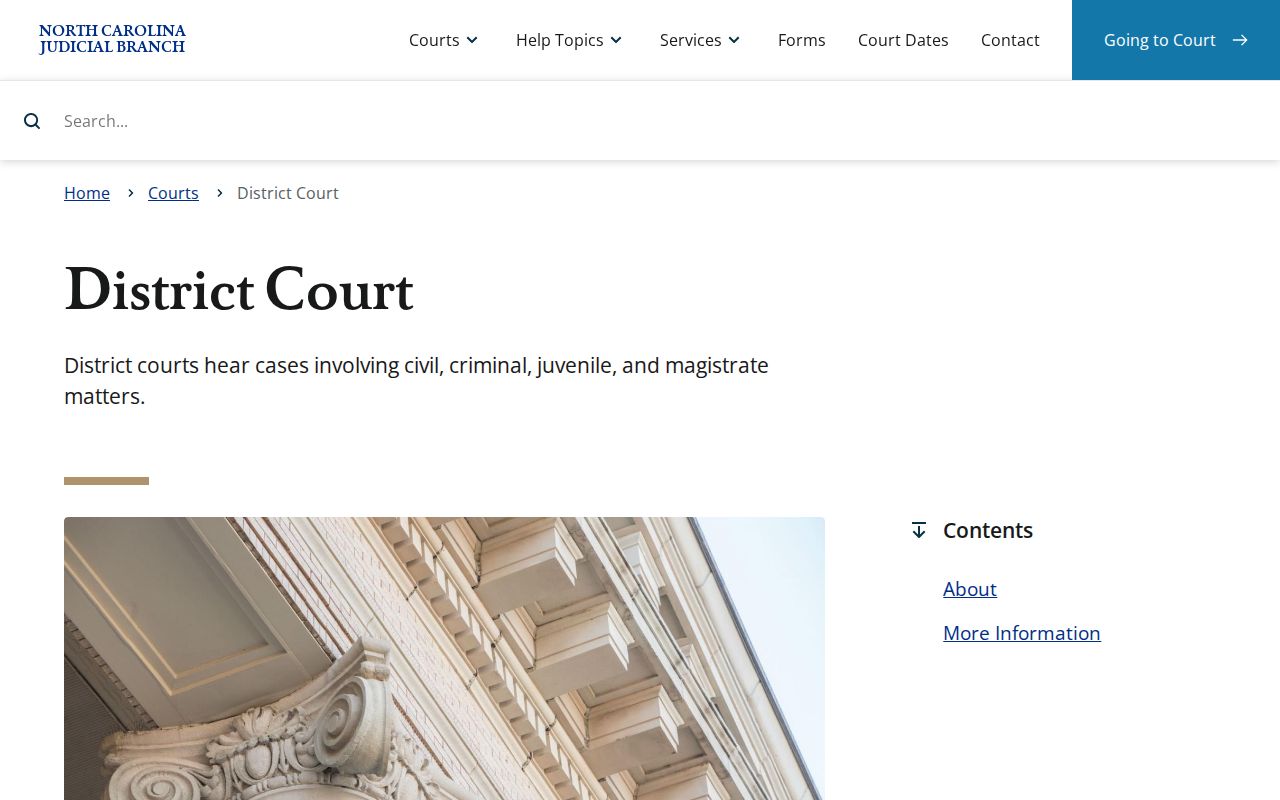
It shows how a misdemeanor or infraction record can share one clerk and Portal path with a Superior Court criminal record while sitting at a different court level.
Inside a Jackson County Criminal Docket
A criminal Case Summary is a dated register of case events, not a story of the accusation. The Portal uses plain labels rather than local codes. Case Events list dated actions. Hearings show scheduled court activity. Dispositions record outcomes where one exists. Financial Information may appear when applicable, and a missing financial panel does not prove there is no obligation. Smart Search is the official channel for checking a balance shown on a docket.
| Record number | Enterprise Justice uses a two-digit year, case-type letters, six-digit sequence, and three-digit county identifier. The state example is format-only: 21CR000003-910. |
|---|---|
| Court assignment | Case and Assignment Information help distinguish a Jackson Superior Court felony context from a District Court matter. |
| Case Events | The dated register of actions. Read it in sequence and use a full description rather than guessing at shorthand. |
| Hearings | Scheduled court activity. Search Hearings is the separate Portal tool for current location and time. |
| Disposition | A recorded case result or status outcome, distinct from a pending hearing or earlier case event. |
For a document behind an event, first check whether a public image is available. Then ask the Jackson clerk for an official copy if you need one. Viewing a document online does not make it a certified record.
Jackson County Criminal Calendar Practice
The Jackson County criminal calendar works as a companion to the individual Case Summary. It is never a substitute. The county court page posts the Jackson criminal calendar. Portal Search Hearings tracks the next setting by case, party, attorney, judicial officer, or courtroom. A calendar only shows which cases belong to a session. It cannot promise an earlier setting stayed put. So match the calendar against the live Portal view any time a date matters.
The 43rd Prosecutorial District's Superior Court Criminal Case Docketing Plan sets its own timing rules. Administrative-setting calendars go up at least ten days ahead of the next administrative setting. Attorneys and unrepresented defendants get printed calendars under the plan. Internet posting stays at the clerk's discretion, though. That is why a paper copy or a call to the clerk still beats a dead web link.
For the full set of local rules and forms, the Judicial Branch local-rules library publishes the procedures. Those procedures govern a Jackson County criminal docket.
The local-rules source explains what an administrative setting is, but the current case record still controls a case's status. Treat the plan with care. The cited docketing plan is dated May 1, 2019, so confirm current local rules before relying on it for a future setting.
How a Criminal Case Moves
A Jackson criminal docket may show a filing, an arraignment or other early setting, pretrial activity, a plea or trial path, a disposition, and sentencing-related events. That is a general path. It is not a promise every file follows the same order. Trust the documented Portal fields over invented event codes. Case Events, Hearings, Dispositions, and Financial Information each describe a different slice of progress.
Jackson criminal docket flow: Filing → Arraignment → Pretrial → Plea or Trial → Disposition → Sentencing.
An administrative setting is a local Superior Court session for calendar administration. Do not assume it is a trial date. Check the next hearing and the most recent events before planning around any entry.
Jackson County Criminal Docket Events
A few plain terms go a long way on a Jackson County criminal docket. A hearing is a proceeding on the schedule. A disposition is the outcome a court has recorded. A continuance only pushes a matter to a later date. It never means the case is over. The criminal calendar lists county sessions. Search Hearings and the Case Summary track one case through the Portal. Knowing which channel you are reading matters when the same Jackson County case shows up in more than one place.
- Case Summary / Register of Actions
- The public Portal's detailed case timeline for available information and events; it is not an official certified record.
- Administrative setting
- A local 43rd District Superior Court criminal-calendar session used for administration of pending criminal matters.
- Case Event
- A dated action or progress point in the case timeline.
- Continuance
- A postponement to a later date, not a dismissal or disposition.
The county publishes no official glossary of event codes. So read the full event description the Portal gives you. If an abbreviation is still unclear, ask the clerk about the public record behind it instead of guessing at what the letters mean.
Courts That Hold Criminal Dockets
Two trial courts hold the criminal work. Jackson County Superior Court, part of Superior Court District 43B, tries felonies before a jury. Jackson County District Court, District 43, handles misdemeanors and infractions. One office, the Jackson County Clerk of Superior Court, keeps the files and dockets for both levels. The eCourts Portal is the shared public search path. Check the court assignment in a Case Summary instead of assuming every criminal case sits in a single calendar.
The tool depends on the charge. For a felony or indictment, use Smart Search, Search Hearings, the Jackson criminal calendar, and the local Superior Court docketing materials. For a misdemeanor, infraction, or state traffic ticket, start with the Portal and the criminal calendar. Then turn to the clerk and courthouse channels. A magistrate's preliminary or limited function still runs inside the unified Jackson court-and-clerk system.
A notice of appeal may show up in the trial docket. The appellate record is a separate thing. Final trial-level appeals generally go to the North Carolina Court of Appeals, and the Jackson record does not become that appellate docket.
Jackson County Criminal Calendar Sources
Jackson's public court gateway splits its material into calendars, local administrative schedules, payment information, rules, and online services. A seasonal District Court schedule gives session context. The criminal calendar lists county sessions. Portal Search Hearings gives a current hearing lookup for a single case. When these sources conflict or a public result is missing, the clerk is the fallback for the court record itself.
For county-level context, the state publishes criminal and infraction case-activity reports by county. Jackson County reporting sits inside them. The workbooks do not break out a Jackson row. The report gateway alone supports no inference about filing or disposition totals.
That official report is the state-level companion to a Jackson County criminal docket search. Use it for context, not for any one case.
The report channel paints the county picture. For an individual Jackson criminal case, the Portal and the clerk remain the paths that matter.
Sealed Dockets and Public Access
North Carolina law presumes public inspection of the records, files, dockets, and indexes a clerk keeps. Another law must say otherwise to close them. In Jackson County, the Portal opens public case types to anyone. Public self-service terminals at a clerk office add another search channel. No Portal account will unlock a restricted record. No broad name search will either, if the record is confidential, sealed, expunged, or otherwise restricted.
Juvenile records stay closed except where a statute or court order permits access. An expunged record is more than a missing public hit. The retained expunction file is confidential under state law. Portal guidance also lists restricted items. Unreturned criminal warrants and protective orders are examples. A blank result can mean several things. It may signal a restriction, delayed entry, a filing in a different location, or simply the wrong search criterion.
Public-access rules:
G.S. 7A-109 requires clerks to maintain court records, dockets, and indexes and generally makes them open for inspection unless a law provides otherwise.
G.S. 7B-3000 makes juvenile records confidential except for authorized access.
G.S. 15A-151 limits disclosure of confidential expunction files.
The official juvenile-record statute supplies this Jackson County criminal docket access visual.
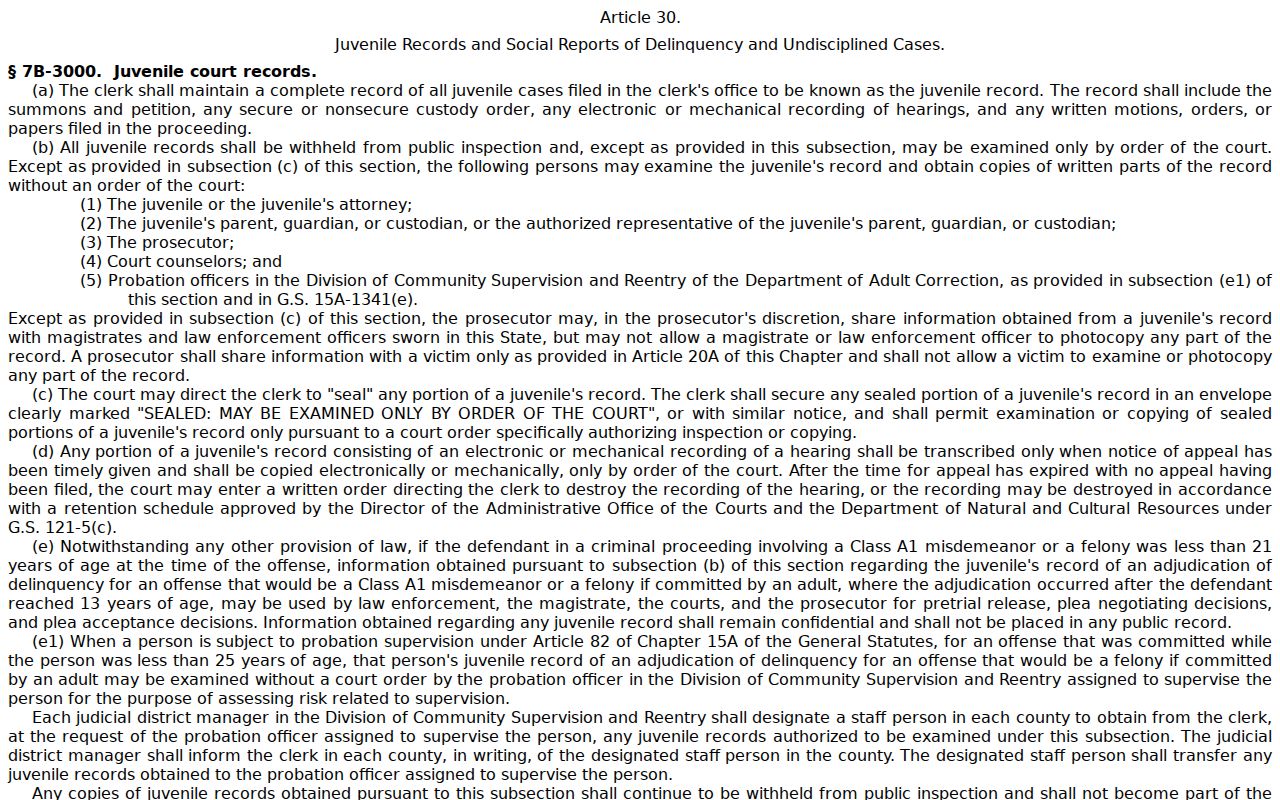
The statute sets a real limit on access. Treat it as a reason to respect that limit, not as a prompt to hunt for the protected file in some other public database. The official expunction statute gives a second access reference for anyone tracing a Jackson County criminal docket.
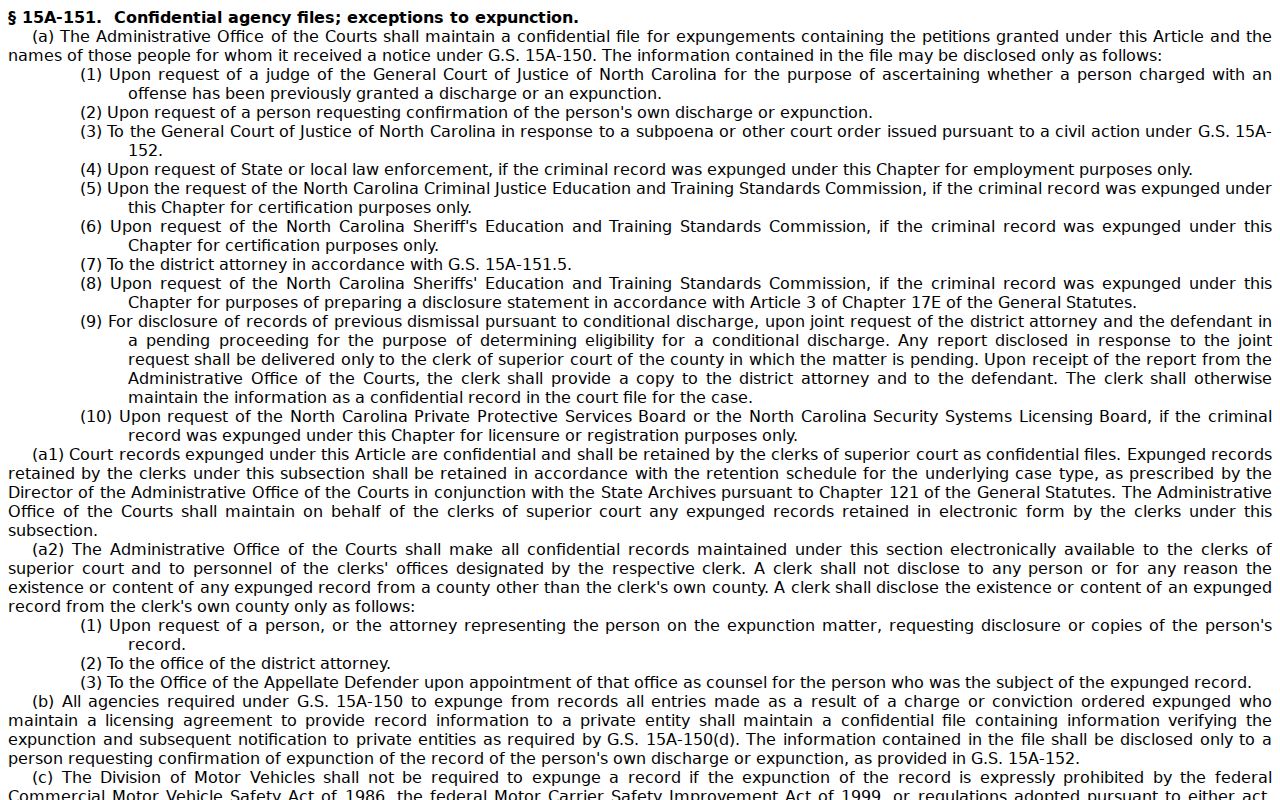
It confirms the point: a request for an expunction file follows a narrow statutory access rule, not ordinary public-docket practice.
Jackson County Criminal Docket Gaps
When a Jackson County criminal docket does not turn up online, restart. Use the most precise search key you have. Portal guidance supports several keys. A case number, party name, citation number, attorney name or bar number, and other advanced criteria all work. For a name search, try the exact spelling first before using the documented wildcard approach. Keep in mind that a filing can sit unprocessed, a record can be restricted, or the matter can belong to another court system. A blank result is not proof that a case never existed or that it ended.
The next stop is the Jackson County Courthouse and Clerk of Superior Court. It sits at 401 Grindstaff Cove Rd., Sylva, NC 28779. Call (828) 631-6400. Public self-service terminals can supplement web searching, and the clerk handles file inspection, copies, and certification on site. The Judicial Branch courthouse page lists weekday hours of 8:30 a.m. to 5:00 p.m. Call ahead to check holidays or a specific division channel.
Note: A clerk can point you to the proper record channel. Legal advice is different. A clerk cannot give legal advice about the criminal case or its strategy.